By Guro Jeff Davidson. Originally published in 2013 and republished in 2014.
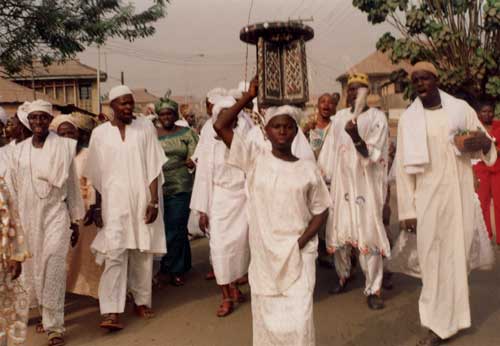
Learning in southwestern Nigeria
I took a serious interest in the culture of the Yoruba people of Southwest Nigeria in the late 80's. Throughout the 1990's I was fortunate to be able to study under some very knowledgeable Elders such as Medahochi Kofi Omowale Zannu, Chief Adebolu Fatunmise, and Dr. Afolabi Epega. I made my first “pilgrimage” to Yorubaland in 2001, and have returned every year since with a new group of select, intrepid students for continuing education.
The Yoruba have an indigenous martial arts tradition that is largely unknown outside of West Africa. Interestingly enough, their arts appear quite different that the Muslim-influenced martial traditions typically found in the North. A close parallel to the Filipino Martial Arts is that the Yoruba styles are essentially the same theme with variations from village to village. I have observed these fighting styles in Ode Remo, Sagamu, Ile Ife, Ibadan, Abeokuta, as well as in ethnically Yoruba enclaves found “next door” in the Republic of Benin.*
The Yoruba word for warrior is Akin (literally “A Brave Person”). Akin can refer to a prolific military leader or even a distinguished hunter (Ode). In traditional culture, hunters exist on the very fringes of society, and have an extensive awo (secret knowledge) pertaining to fighting and combat, yet are not what we would think of as “martial artists” in our common usage of the word. Some of the terms used to describe martial arts practitioners as we would think of them are: Oniijakadi, Alonilowogba, and Eleeke.
Gidigbo
The author uses Gidigbo as an umbrella term for Yoruba martial practice and notes that he does not know an exact translation. He describes wrestling alongside other disciplines and compares them with traditions of neighboring Hausa communities. In his account, matches took place at social functions and regional sporting events as well as at occasions linked to village life.
The savvy Oniijakadi does not rely on mere physical strength alone, but brings all manner of strange charms (juju), incantations (awure) and paraphernalia obtained from a trusted Onisegun (medicine man) to the fight in order to gain an edge over the competition. This is very similar the concept of orasion (prayers) and anting-anting (amulets) in Filipino martial culture.
Returning to Nigeria and Benin
Whenever he returned to Nigeria and Benin, Davidson met with teachers and training partners from earlier visits. He brought students on later trips and reciprocated by sharing some Kali. He recalls time in Ijebuland, practicing with teenagers and continuing the conversation over refreshments after training.
The original article closes with a note about Davidson’s recordings of matches, festivals, and interviews with fighters and teachers.